Showing posts with label Indian Travel. Show all posts

22 May 2013

Through the corridor of tranquillity


View of the forest,Mahananda Wildlife Sanctuary,Siliguri
Was that a scream of peacock? I made everybody silent to hear the screaming peacock. In the fascinating thicket of total silence, only the skittish movement of butterflies on the anther could be seen. Somewhere it was only the dripping sound of the water drops falling on the leaves and somewhere it was only the cricket`s call coming out of the vague visibility of the extreme core of the bushes with the reverberation, spreading all over in the kingdom of silence. Sometimes, like getting scared on envisaging the shadow of tuskers behind the camouflage of thick bushes, somewhere it was river Mahananda, where an eternal peace was felt, dousing the feet into the indefatigable fluvial flow of glacial cold water.

At the entry gate of Mahananda Wildlife Sanctuary,Siliguri
Saw the deer, that was kept in an enclosure, was busy in eating the fodder, repeatedly came back after it was released it in the core forest. Some thing was there in its innocuous dark eyes, was that a complaint against the rapacious civilization? Was a death threat? Or complaining of the apathy towards the shrinking wilderness and building blockade on the corridors of the wild animals? I am still asking myself.

The captivated wild at Mahananda Wildlife Sanctuary
The scenario of shading the shrivelled leaves by a gentle breeze, also bring the sound of forlorn whispers, of shrinking wilderness with increased urbanisation. The sound of frustrations comes in the murmurs of the withered leaves. Are we heading towards a civilization where the wild animals could be seen stuffed in the museums only? The espying alarm call of the deer coming from the deep forest made me alert, thinking of the multitudes of predatory animals. It was time to depart, from the vicinity of tranquillity and prayed to god for the fascinating scenic treasure to extricate it from the curse of getting shrunk. We took the road to home, the setting Sun spattered its lovely hue all over the sky, like it was set ablaze. It was an appeasing darkness in the forest, after truly “experiencing another world”.

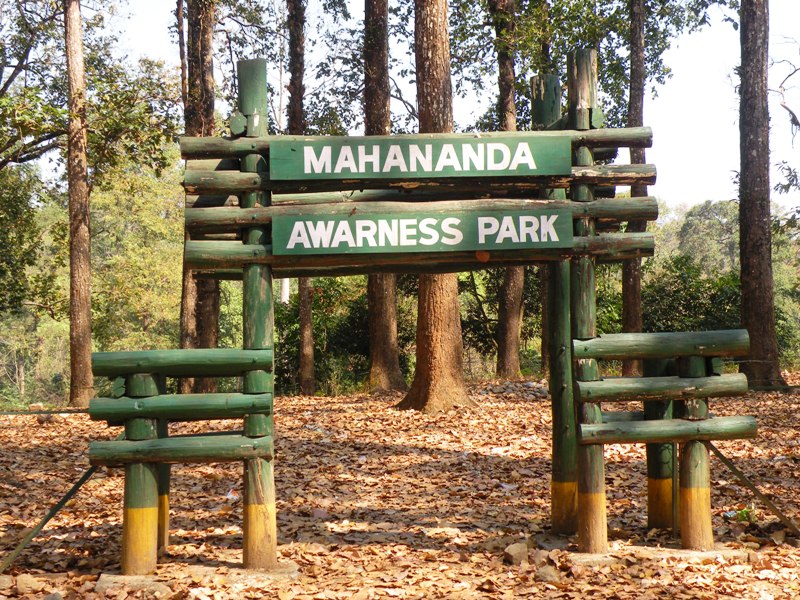
The awareness Park at Mahananda Wildlife Sanctuary
Mahananda Wildlife Sanctuary, through which the Toy train of Darjeeling, began its journey towards history. The train journeys give a feeling of a railway safari ride till the Sevoke through the hypnotic environment. Mahananda Wildlife Sanctuary has an area, stretching over the hilly region of the Darjeeling and Jalpaiguri district. Rich with the flora and fauna is spread over an area of 161 sq. Kms. and very close to Siliguri town.

21 May 2013

In the World of Handicrafts


The spectacular Sun set, through the thicket was so engrossing that, when it was over, I discovered myself amidst a total darkness and the shutters of the handicraft centre of Aamar Kutir were likely to come down. Aamar Kutir Society for Rural Development located very close to the Shantiniketan of Birbhum. The centre was established before Indian independence and was providing a livelihood to several families, directly or indirectly involved with the society. Peeped through the window of the leather batik manufacturing unit and asked for their permission to enter and that was readily granted by the ardent workers who were tirelessly engaged in their work. The efforts of the workers even after a day’s hard work could be seen from their body language and they were not in mood to give up.

The tireless workers of Aamar Kutir,Shantiniketan,Birbhum
The warmth of their welcome was perceptible inside the room also. The arrangements for the leather batik centre, was all open to reveal its explicit techniques that modify a mere piece of leather into exotic handicrafts of glamorous colours.

Colour filling at Aamar Kutir center
The exploration began, to unfold the techniques of leather batik amongst some passionate workers, could not notice us or habituated with the visitors. The complete processes of leather batik comprise of few major steps. The leather pieces pass through the embossing unit where the traditional folk art or ethnic designs were imprinted, then the leather pieces were given specific shape, in the next part colour filling was done on application of some sorts of acid dye, then it was stitched and the finished products were stowed for the market. Unprompted stories or complete process of making of leather batik could be heard from the workers.
through the process at Aamar Kutir Batik center
The finished handicrafts were marketed within the premises and even exported. The manufactured products of diverse ethnic handicrafts were like galore of discriminating colours, from leather to cotton. The Batik of the Birbhum district adored worldwide, representing the ethos and rich heritage of India.

way to the market at aamar Kutir
In Shantiniketan, such small scale industries of handicraft were largely in existence and were even run by the local women from their home. The rural folks were also engaged in the venture and have generated a source of their income.

Batik print on sari,Shantiniketan
In Shantiniketan, I have visited the boutique of an energetic and innately talented old lady, was running her business from home. Her indubitable artistic works and creative ideas were reflected in every piece of her work. The exalting innovative ideas could be seen on design of kantha stitch, batik on cloth, and embroidery works, even the selection of colours, threads or everything were unique.

11 May 2013

The perfect day out


The bright sunny day of stainless autumn sky in the backdrop of dazzling Kanchanjungha, the ingredients were perfectly matched for our day out in Kalimpong, with Yogesh. The young man was very relaxed to share his stories of life while driving the car.

the ultimate natural backdrop at Kalimpong
Dr. Graham`s home was eternally peaceful with its vast and picturesque landscape surrounded by the eye catching century old buildings. Previously known as the St. Andrew`s colonial homes and renamed Dr. Graham`s home, after the name of its founder, John Anderson Graham. The Scottish missionary, among his other contributions would continue to live in the mind of peoples of Kalimpong, for his relentless effort to educate the children of the weaker section of the society and effort to enlighten the local cultivators with modern techniques. The wide open surrounding of the Institution was established with the perspective of broad thinking, evoked the lines in my mind,
                   ..................... “Where the mind is led forward by thee
                                           Into ever-widening thought and action
                       Into that heaven of freedom, my father,let my country awake”
                                               
                                                               From the lines of the poem,
                                 Where the mind is without fear by Rabindranath Tagore

Dr.Graham`s home,Kalimpong
Rabindranath Tagore visited the historic Institution and amidst the serene vast landscapes with heavenly tranquility the two great men had their communions.

the building inside the premises,Kalimpong
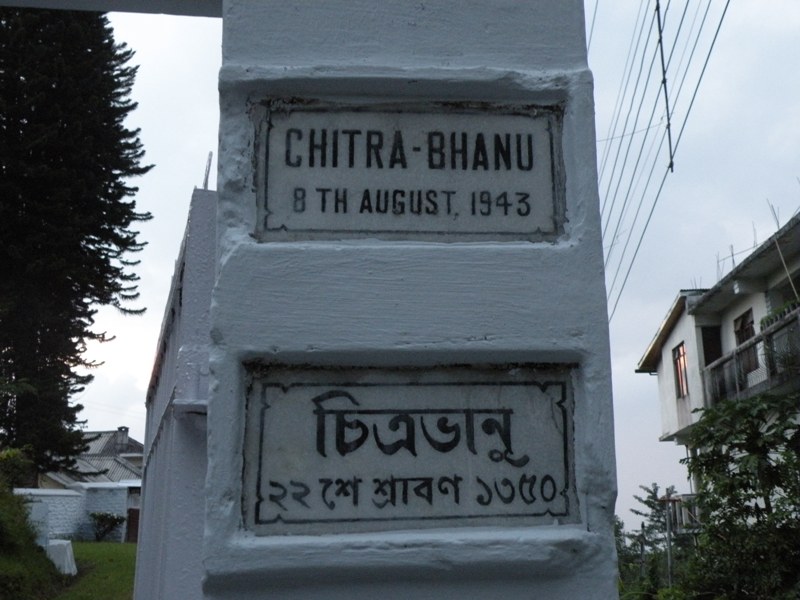
Yogesh was very keen for my complete sightseeing in Kalimpong before the dusk. He was certain that Chitra Bhanu was the house where Rabindranath Tagore used to spend his days in Kalimpong. He said every time he came, he found it was locked. The fact was, Chitrabhanu was no longer an existing property of the Tagore family though it was constructed by Pratima Devi, daughter-in-law of Rabindranath Tagore and visitors entry were restricted after it was acquired by the Education Directorate of the state,in 1965.
Yogesh was unaware; actually it was Gouripur House, where Rabindranath Tagore, the great litterateur, did spend his days in Kalimpong on few occasions, and he inaugurated the live broadcast of the All India Radio from Kalimpong. In spite of his illness, Rabindranath Tagore, visited Kalimpong for the last time in 1941, and was taken to Kolkata from the Gouripur house, after he was seriously ill. Construction of Chitra Bhanu was complete after Rabindranath Tagore`s death.

in front of Chitra-Bhanu,Kalimpong
Kalimpong was very attractive destination with its outstanding picturesque beauty to bask under the munificent environment. The unique architectural buildings of Dr. Graham`s home with its hypnotic environment was speechlessly mesmeric and still indelibly engrossed in my mind. At the same time it was very unfortunate; “Gouripur house” was not a familiar name even among the local residents. Gouripur house would have the same importance as Dr.Graham`s home, from the tourism point of view and at the same time, deep concern was required in preserving the memories of our Nobel laureate.

2 May 2013

Souvenirs of Puri


        The stupendous view of the Bay of Bengal was slowly getting subdued by the paced approach of the darkness. The glaring Sun lost its intrepid vigour and immersed into the horizon of the west. The endless bellow of the sea waves could only be heard in the dark. On the other side, another exuberant atmosphere was in the making, as the sea shore based business plazas were getting dressed for the evening. The beach side lights, decorated like sparkling garlands, started to glitter attractively, and it was the time to turn our attention towards another direction.

display of dresses
            The devoutly visit to the abode of Lord Jagannath was complete; long hours of sea bathing, and the sightseeing were over.
             On the outset of collecting the souvenirs of Puri, as well as the urge to purchase some of the articles of  the household, I was dragged to the heart of shopping plazas located at the ever chirpy premises of Swarga-dwar.

pile of Kotki cottons
           The available wide choices for mementoes were, from the Odishi printed clothes to different sweets. The outlets of Odishi printed cottons or Katki were selling their products with squashing demand. Varied dresses, ethnically printed bed sheets, saris, have large number of admirer, and the piles of stock could be seen to be sold out like evaporating instantly before the eyes.

view of stalls at the beach
           The stalls at the beach or at the footpath were selling various forms souvenirs with innovative design, even tiny key chains, locks, bangles, and Chinese toys were also seen to have their positions among the other mementoes of Puri.

sea shell items
           Exclusive shops of sea shell items were also doing fairly good business. It was rollicking business in every space with a bit haggle, but under a convivial atmosphere.

aluminium store

            The metallic artifacts were another exemplar of the ethnic memento. Mementoes in the form of aluminium or the other metallic articles could also be purchased from the reasonable number of exclusive shops. The aluminium made items were said to have manufactured at the NALCO factory of Odisha. The aluminium utensils and other metallic products have their distinguishing design.

souvenir
            The Puri-r Goja or Goja of Puri has been indubitable source of appeal for the sweet lover tourists. Goja, the typically shaped slight hard sweet, like crunchy biscuits, are made of wheat flour and sugar as their main ingredient that is dipped into sugar syrup after a deep fry. The Goja also offered before the Lord Jagannath, and the sweet has always been adored by the tourists and pilgrims of Puri. Exclusive stalls of Goja displayed attractively are very common scene especially at the Swarga-dwar. The eye catching sweets have inimitable taste, and I have seen that huge stacks of Goja to get exhausted instantly after they are displayed.

stalls of Goja
             My visit ended with the sweet memoirs, without too much crunch on the budget and obviously with the bags entirely tight packed with the souvenirs of Puri.

22 April 2013

Thotlakonda: the story unveiled


We were on our way to the place where the 2000 years old relics of Buddhist monastic complex have been unearthed on excavation. The monastic ruins of the settlement of Mangamaripeta or popularly known Thotlakonda, were 16-kms away from the Vizag town, at the top of a hillock and near the quiet seashore of the Bay of Bengal. The place offered an exquisite view of the Bay of Bengal. It was silence everywhere and my vision leaped from the hill top and far away it appeared like a point of meeting of the sea, sky and soil, a splendid picture frame of soothing colours. The picturesque tranquil surround was perfectly suited to meditate in the midst of the gracious nature. The wide view of the generous sea shore, meeting with the hill and deep blue sky made us spellbound. The Buddhist monastic teachers found their ideal place for establishing the college of religion.

Bay of Bengal from Thotlakonda
The relics of the settlement were first noticed during an aerial survey of the Indian Navy, and consequently an archaeological excavation unveiled the unuttered stories of the Hinayana Buddhist settlement of around third century B.C. The Hinayanas believe that, strict monastic life only can lead to the Nirvana. This sect of the Buddhism is considered as the earliest version of Buddhism and they firmly defy all worldly comfort on their way to attain the Nirvana. Third century B.C. was to some extent during the reign of King Asoka of Kalinga (during 273-232 B.C.) who also accepted Buddhism. The period when the Indian sea traders had business ties with many countries and many kings of India accepted Buddhism and took initiatives to spread the Buddhism worldwide. Under the Royal patronage, Buddhism was accepted as the state religion of many countries and students from different countries used to come to India to receive religious lessons ignoring the fear of unknown routes. The Hinayana Buddhists are now limited to mainly in Sri Lanka and Myanmar.

relics of the settlement at Thotlakonda
The base structures of the relics were seen only rose on the earth. The design of the monastic constructions could be imagined from the miniature stupas, spread near the unearthed complex.

miniature structure at Thotlakonda

The monastic complex had everything in it, Kitchen, dining hall, prayer hall, hostel, assembly halls. The guide took us to a reservoir, still filled with water. The perennial source was used for main storage of drinking water in the complex and was fit for consumptions even few years before also. The drinking water supplies in the complex were made, through many dug cisterns on the solid rocks of the hillock. It was amazing to watch an example of rain water harvesting in a place, surrounded by the sea.

reservoir at Thotlakonda Buddhist settlement
The relatively calm sea shore of the Bay of Bengal was ideal for the voyagers to anchor their ship and the shore line could be monitored easily from this hill top. On excavation, several Roman coins among other articles were also unearthed from the relics, which indicate towards the business ties with that country. It was said, that the complex was deserted near the third century A.D. due to some probable reasons, might be due to the fall of sea trading between other countries or may be due to other rising religions or other sects of Buddhism started to gain popularity. Since then, Thotlakonda, the deserted heaven on earth remained unnoticed and got veiled under the cover of time. In such an isolated place, it was the hard work, which was the inspiration behind the establishment of a human settlement that existed for several centuries.

18 April 2013

Toy Train of Darjeeling


It brings in mind, of a fairy land, covered with picturesque hills, where the clouds play hide and seek with snow clad mountains. It was like listening to the fairy tale in the form of Toy Train, where the coaches of the train were like match box and tiny engine used to drag the coaches on narrow track at very slow speed that, even a bicycle rider could easily overtake a running train. It was enigmatic to hear that the fun seekers even used to board in or exit from a running train. Since childhood, I used to see the toy train in my dream, moving up to the land of happiness in a dazzling Sunny day, through the lush green forests. The passion began to witness the toy train since childhood.
My first encounter with the sweetheart of my childhood, when I saw, the toy train was on its way getting disappeared in the thick cover of fog, is still fresh in my memory.

Toy Train engine at Darjeeling
When it was observed from close, I found the presence of history everywhere. The Railway stations, in the coaches that used to carry passengers, in steam engines, in the car sheds or in the unique environment of the nest of the toy train i.e. Darjeeling where the history, the legacies of the past could be felt. The dream child of the then rulers of India brought revolution through its wheels in the history of transportation system.

monument at Sukna
The toy train began its first phase of journey to the Darjeeling hills on the 23-rd August 1880. Sukna, the place 11-kms away from the Siliguri happened to be most important rail station, in the golden days of the Darjeeling Toy Train. In this part, first Indian Toy Train service was introduced, that subsequently resulted establishment of new localities and brought development in those areas. The idea of laying a railway line through the terrain of the Darjeeling hills materialized transportation in a big scale. On its journey, a person used to stand in front of the steam engine, and sprinkle sands on the rail tracks, to ensure a solid grip of the wheels on the track. The toy train in its heyday used to run to and fro with passengers and cargo between Siliguri and Darjeeling. The rail tracks or the narrow gauge of the toy train were initially laid through the heart of Siliguri town and in 1962 that was diverted and extended through a different way. The rail tracks on which the Toy train began its journey have been buried under the asphalted Hill Cart Road in Siliguri town. Toy train or the Darjeeling Himalayan railway came under the North East frontier railway in 1958 with the motto of “Service before Self”.

Darjeeling Rail Station
The easy going days lasted no more, as speed was slowly getting introduced in life and the motorable road to Darjeeling started to become popular because of fast and time saving journey, the toy train remained a mere attraction for the joy ride.

Toy train in a new look,Darjeeling
New diesel engines were introduced, to add pace in the wheels of the toy train. The Darjeeling Himalayan Railway was the first Indian Toy Train service to be awarded with the title of World Heritage Site of the UNESCO. It could be seen, different states of India, where toy trains earn good revenue with modern infrastructure. We the lovers of Toy Train of the Darjeeling Himalayan Railway love to see it again to be running fast, reminding of the memory lanes to the hills of peace and tranquility, loaded with passengers and steaming off all the worries, the tiny wheels will revolve again to run, playing hide and seek through the mountain ranges.

5 April 2013

A ritual 215 ft above sea level


As the person appeared on top of the Jagannath Temple of Puri and started to change the flag, the crowd gathered there, started cheering up, “Jai-Jagannath”. Everyday a new flag is prepared of triangular shape and a person climbs up the temple at sunset, his back supporting with the wall carrying the bundle of new flags, and after changing the flag, he brings down the previous days flag and climbs down, with his back supporting on the temple wall.
The Jagannath temple 215 ft.high, where the flag is replaced every day throughout the year, at the sunset. Except during the period of the Rath yatra ,and simultaneously a new flag is hoisted with a post, attached to the Chakra (wheel).The Chakra or Wheel is at top of the temple, made of eight types of metals, 11 ft. 8 inch. in length and circumference is 36 ft, the wheel is also called the Neela Chakra and Vishnu Chakra. The Jagannath Temple is an excellent example of Kalinga architecture. During the eighth century to eleventh century the temples of Odisha, were constructed. Temple of Lord Jagannath was constructed during that period.

The Jagannath Temple of Puri
The person hoists the flag everyday belongs the family or the sevayats who were given the rights for hoisting the flag 800 years ago by the king who built the Puri Jagannath Temple. To overcome fear of height, the male members of the family are to practice vigorously and learn the art of climbing the temple starting at an age of 10-12 years. It is very thrilling sight to see a person climbing such a high temple without any climbing gear or any other external support. It is believed to bring luck if a piece of flag can be collected from the hands of the person, who hoisted the flag. The man starts distributing the flag or piece of the same among the pilgrims immediately after coming down from the top. It is believed the extent of earning result is the same, as the extent of faith on Lord Jagannath.

How to reach: Puri is well connected by Rail and Road, with all the parts of rest of the India. Puri can be reached by direct trains or the trains to Bhubaneswar can be availed, and Puri can be reached by road or rail from Bhubaneswar. Website of Indian rail indianrail.gov.in can be visited for details.

3 April 2013

Buxa (the land of rare species)


Buxa Tiger reserve is popularly known for the numerous species of animals and birds.I saw a big sized lizard,busy in catching the insects.
Tokke at Buxa
The lizard was looking fearless and did not move even when I was very close.I asked a man of our guest house,he said, it was a snake (reptile) called "Tokke" or "Tokke geko".As they emit sound like that,as their mating call.It was big eyed and bluish in colour. In the evening I heard sound "Tokke",it was said that they often bite the human being when disturbed,causing a burning sensation,prevailing for few days.They are nocturnal and get hidden during the day.The lizards are mainly found in the surrounding of human habitations. The species were getting extinct and very few are remained.It was due to the trading of this lizard for their skin or so called medicinal use.

living colours of the Buxa
For hatching of their eggs,the Hornbills choose holes of long trees.When the time comes for the female to lay its eggs,she enters into the hole and they seal the entrance of the hole with mud and its droppings.Only a small hole is kept,through which the male hornbill feed the female throughout the period of incubation.

The great Indian Hornbill at Buxa
Last Tiger census in the Buxa Reserve Forest revealed the existence of around 20-tigers in this forest.Huge number of species of mammals,and birds were spotted to have existed in this forest.

Dooars : Chapramari Wildlife Sanctuary


the panoramic view to Chapramari Wildlife Sanctuary
The Jeep was running through the road (NH-31) crowded with the vehicles.The forest on both the sides were looking very impressive and the notice for slow drive through this area was seen,as it was a corridor of wild elephants.I was very hopeful about sighting the wild elephants and was dreaming of a herd of elephants crossing the road.I was looking as long my sight permitted through the trees to trace the wild animals.The Jeep took a left turn and an entirely new world of nature opened up in front my eyes.This road was different with few cars were plying and I was so amazed by the beauty of the forest that, apart from watching wild animals, I would have spent my time watching the panoramic view.The grove of trees were upright and looked like strong men in their youth.Even the colour of the leaves on trees were different on either side of the road.The beauty of the environment was charmingly beautiful.

the entry point of the Chapramari Wildlife sanctuary
The Jeep turned to left and we were at the entry gate of the Chapramari Wildlife Sanctuary.The man at the visitors` check-point was very calm to tell us that witnessing the herd of elephants and bisons were very common .As the gate was opened,we were within the area of Chapramari,one of the oldest wildlife sanctuary of this area.The trees with in forest area were a real beauty.

the herd of Indian Bisons at the Chapramari forest
Suddenly a herd of Indian Bisons or Gaur were sighted in the forest,and the Jeep stopped.The herd were so close to us with their massive sized males,very strongly built,it looked like a football team in their white socks,and I took enough photos to satisfy my hunger of sighting wild bisons. The herd had their young members with them and kept watching them till they entered into the deep forest. The guide spotted peacocks many times,Saw huge Hornbills were flying off,and a flight of Parrots on the way to their nest. Chapramari Wildlife Sanctuary is one of the most attractive destinations of Dooars. Chapramari forest can be visited from the Gorumara National Park from where permission to enter into the forest area of Chapramari can be obtained,and the forest has a good density and variety of wild animals. well connected by Rail and Road.Nearest Airport-Bagdogra.West Bengal Forest Development Corporation has their lodge – Panjhora Wilderness Camp,Murti Cottage,etc.staying where the beauty of Chapramari can be witnessed with a safari ride.The forest remain closed during 16-th June to 15-th September every year.

2 April 2013

....and the Sunrise at the beach


Sunrise has always been a matter of priority to me,every time, wherever I go. After reaching Puri,Odisha, I got ready to experience the Sun rise at the beach. Sun rise and Sun set can be experienced from the same point standing at the Puri beach. It was around 4.00am and little cold was perceived, the day was windy too. Without making any delay, I picked up the camera, I was afraid of missing the view of Sun rise, so I ran for the Sea beach, and was praying to God for a spectacular Sun rise.

the journey for a livelihood,Puri
Standing at the beach,experienced another scene of beauty,the fight between the stormy waves of the Bay of Bengal with few undaunted persons locally known “Nulia” or the fishermen. They also serve as Lifeguards for the tourists. The fighermen were taking their fishing boats into the Sea. They were making their way into the sea struggling with the violent waves. I could see sometimes their boat was getting almost vertical up by the thrust of the waves and sometimes getting hidden on the other side of high waves. I remained spellbound while watching them sailing towards their destination.

 men at work,Puri
It was a team work,some of them gone in a boat in the Sea and some stayed at the beach holding the rope of the fishing net tied at the boat.

waiting for the catch,Puri beach
After the boat reached at certain spot, the fishermen on the boat started spreading their fishing net,and the men at the shore started pulling the other end of the rope of fishing net,and slowly the net with the catch was brought out of the water. I saw them catching fish that way at-least twice before the Sun rise.

team members of the fishermen,Puri
The tourists were getting gathered for having a look of the fish on their stroll at the beach,some of them were buying too.

the catch at Puri beach
They were selling the fish at the beach in a peculiar way,they filled one side of their weighing beam balance with sand and other side they weighed fishes.

beam balance at the Puri beach
Finally saw the Sun rise,it was fantastic,the sea started glowing in goldden colour with the ascending Sun of the morning. The light started filling the surrounding,the warmth of the Sun took away the cold of the early morning and the crowd that gathered to watch the fishes, slowly got dispersed.

the sun rise at Puri
Enjoyed watching the Sun rise, that appeared from the heart of Bay of Bengal. But, It was more charming to watch the daredevil fishermen, challenging the turbulent sea for their livelihood.The Sun rise was definitely spectacular but,watching the Nulias and their daily routined fight for life was even more spectacular.


life guards of Puri
How to reach:Puri,is well connected by Rail and Road,with all the parts of rest of India.Puri can be reached by direct trains or trains to Bhubaneswar can be availed,and Puri can be reached by road or rail from Bhubaneswar.Website of Indian rail indianrail.gov.in can be visited for details.

9 January 2013

Sunrise at Tiger Hill:Darjeeling

The place Tiger hill,Darjeeling can be visited,throughout the day,not only to witness the Sun rise in the morning,but,also to capture the colour change on the Kanchanjungha throughout a day(especially on a clear and Sunny day) from such an excellent location.A place that is located at the top point of Ghoom,popular for the highest railway station under the century old Darjeeling Himalayan Railway,the World heritage site.Situated at an altitude of 8550 ft. and is perfect place for viewing Sun rise,with no obstruction in front.A place to witness a nature made movie resuming with the first ray of Sunlight from the East and as it fall on the peak of the Kachanjungha the picture begins. 
                                                   It is mesmerizing experience to witness a Sunrise from the Tiger hill,Darjeeling.In a clear and sunny morning,the picture of a Sunrise is complete,when it is experienced with the simultaneous illuminations,on the peaks of the Kanchanjungha, caused by the Sun rays.The snow clad peaks of the Kanchanjungha then appear from nowhere in the darkness and immediately with the Sun rise, different colours of the Sun rays start playing in the sky. As the Sun ascends more, colour of the mountain peaks gradually get changed from light pink to dazzling yellowish-orange.The process of changing colour on the peaks of the Kanchanjungha continues throughout the day.Thus leaving an indelible impression of the Sun rise in minds.
                                             The beauty that is observed,in a clear morning,the experience of watching the Sun-rise from the Tiger Hill,Darjeeling is like something that can only be felt within, rather very difficult to express in words.The Sun rise can be viewed at many tourist destinations, famous for the Sun rise spot,but, colours that play before the eyes in the sky at the Tiger Hill,right from the beginning of the Sun rise, with the simultaneous colour change on the snow clad peak of the Kanchanjungha (the third highest mountain peak in the world) is definitely a rare of rares.The Mt.Everest, the highest mountain peak on earth,standing at a distance in straight line horizontally, about 107-miles from the Tiger Hill,can  also be seen,in a clear morning.


Darjeeling Railway Station

The Manager of our Hotel arranged the vehicle for our Tiger Hill trip in the morning next day.It was said that we should leave our rooms positively by 3.30am. to reach the view point by 4.15am.,as that was the optimum time to reach the Tiger hill. For the late starters,their car would be parked much below the view point behind the other cars, already lined in queue, make them, a compelling more uphill walk in the dark and freezing cold.At the same time a hasty uphill walk, with the fright of missing the view of Sun rise from the beginning,with the fear of not getting a good place to view the Sun rise may invite breathing problem due to high altitude.Similarly,while coming down after seeing the Sun rise a long distance walk to reach the car  is inevitable.So,to avoid the unwanted hazards, it is better to start early in the morning and thus ensure a picturesque sunrise from a proper place .
           
                It was too cold and still dark.We had to get up at 3.00 am and leave our hotel for the Tiger Hill (Darjeeling) by 3.30 am.When our jeep started for the Tiger Hill,it was still night and we wrapped ourselves with the blankets on our heavy duty jackets,to fight the chilling cold.I saw many other cars were also heading towards the Tiger Hill.It was about 12-Kms. uphill drive from  the Darjeeling town.
                In earlier days the Land-rover jeeps or locally called Zonga were used, to carry passengers to the Tiger Hill,where, most of the back seat windows were absent and intense cold wind from all directions used to get penetrated into the bone.Present road to the Tiger hill was new and better, with the introduction of modern SUVs to carry tourists did make the journey more comfortable.When we reached the Tiger hill,the entrance of the main view point was flooded with tourists,busy in buying the entry tickets.Bought our entry ticket to the observation point,with the parking ticket for our vehicle.The approach road was full of jeeps and cars of the tourists parked in long queue.


View of Kanchenjunga at Sunrise from Tiger Hill 


It was very difficult to find out the exact place in the dark for viewing the Sun rise perfectly.The place was so crowded with tourists and it was most important to reach the right place in right time,from where the full view of the rising Sun with simultaneous colour change on the Kanchenjunga would be available in a single frame.


The Sunrise from Tiger Hill

We were waiting eagerly for the Sunrise.The place was filled with peoples of  vast diversity and Tiger Hill,Darjeeling united all of us in a same place,may be for a short time but,it was also a rare experience.
                                   Finally the moment started,it was like a movie, the darkness was slowly getting disappeared,as somebody was taking off  a curtain before our eyes.  The peaks of Kanchenjunga then appeared  like a faint sketch on the canvas of blue sky.As the first ray of Sunlight fall on the peaks of the ice clad Kanchenjunga,it appeared like a father,caressing with his gentle hands of warmth and affection on his sleeping child.
                                         As the Sun started ascending,it simultaneously coloured the peaks of the Kanchenjunga from silver to light pink.The process of colour change went on,starting from the top and slowly spreading down the body of the mountain peak and with time when the Sun did ascend more,the colour got changed to yellowish orange, like huge amount of molten Gold was spreading on the body of the Kanchenjunga  Snowy peaks of the Kanchenjunga was glowing with dazzling colours. It was impossible to take our eyes off. 
                          It was like watching a live painting of God. Every morning on the canvas of blue sky it starts with the first beam of Sun rays and  he colours the snowy peaks of Kanchenjunga in his own style.
                                                
Kanchenjunga after the Sun-rise,from Tiger Hill

At the time of Sunrise,it was very difficult to decide where to capture the memories of Sunrise - In mind or in camera.But,in both the cases the memories of Sunrise are still bright.
            After watching the sunrise at the Tiger hill,the pain of getting up so early in the morning,(when it seems the cold was getting inside the body like a sharp edged pin) was nothing,compared, after watching god`s own  live painting on the canvas of blue sky in front of our eyes.It was a life time experience.

view of Kanchenjunga from Tiger Hill

How to reach:Darjeeling can be reached from Siliguri by Road.Nearest Airport: Bagdogra,Bus-stand: Tenzing Norge Central Bus Terminus,Siliguri and nearest Railway-station: New Jalpaiguri,from where a hired car can be availed to reach Darjeeling.The distance from Siliguri to Darjeeling is 74-Kms. and well connected by road.Arrangements of hired vehicles from hotels (pick and drop) to the Tiger hill are usually made by the Hotel authorities of Darjeeling.Vehicles to the Tiger hill are available in share basis or can be reserved and the website of the tour operators can also be visited for more options. Best time to visit is October to January and February to June,and the rest i.e.experiencing Sun-rise,remains on luck.
Important Tips:Do not haste if breathing trouble is felt,while walking up to reach the main view point.Take rest and walk slowly.Depending on the weather and season warm clothes should be carried accordingly before leaving for viewing an excellent and a safe Sun rise.If possible carry some hot fluid.

8 November 2012

Kalimpong

Early in the morning,left Darjeeling for Kalimpong by car.The hired cars were plying frequently from the auto stand of Darjeeling to Kalimpong .  Kalimpong  can also be reached from Siliguri in almost same time. That time I had a different plan to reach Kalimpong from Darjeeling. A subdivision under Darjeeling District,
Kalimpong is a hill station in West Bengal.Journey from Darjeeling to Kalimpong was very nice experience,the road pass through lush green forests and tea gardens. On the way witnessed the exquisite spot "The Lover`s meet",where river Teesta meets Rangeet. 


Dr.Graham`s home

Kalimpong was reached nearly within two hours. Kalimpong offered me a quiet and relaxed day with gentle warmth of the Sun, to begin my site seeing in the backdrop of Kanchanjungha. 

Katherine Graham memorial chapel

After reaching Kalimpong town, our tour started with Dr.Graham`s Homes, the educational institution started with the  prime target of educating local children of the tea workers and economically poor section, by Dr.John Anderson Graham,the Scottish missionary in the year 1900. The Institution with its large campus has its own poultry,bakery,and dairy,and nowadays students come from different parts of the world for education. 


The Church bell
Within this complex,a Church was built at the top, in memory of his wife Katherine Graham. In the backdrop of deep blue sky, the church attracts the visitors attentions with the uniqueness of architectural beauty right from the entry into the school premises. Constructed in the year 1919, the huge Church  drags the visitors with its alluring beauty, but the church building was abandoned and declared dangerous, as  the  old church building suffered serious damages due to the earthquake and bears severe cracks throughout the body,the church bell that used to ring has become silent, as the entry inside the church building has been restricted. The beautiful church, was likely to collapse any time.


Delo
 
Delo,the highest point of Kalimpong. The picturesque view of the river Teesta, from the Delo hill was like watching the earth from space. The garden of the premises were full of seasonal flowers and nicely maintained.  I can still memorize the wide  and panoramic view of the plains easily and can recall my happy tour to the tiny hill town. A perfect place to capture the scenic beauty in frames as well as in mind.


Shri Mangal Dham
 
The temple premises of Shri Mangal Dham, filled with absolute tranquility would definitely touch the hearts who are in search of mental peace. The walls of the prayer hall portray different Hindu mythological  stories ,it evoked the memory of my childhood days,listening mythological stories from my grand mother.
The house "Chitra Bhanu"built by the daughter-in law of Gurudev Rabindranath Tagore on the 8-th August 1943 (she was married to his eldest son Rathindranath).The house is now acquired by the Directorate of Education,West Bengal and is used as a training center for women and visitors are not allowed in the compound.


Buddhist monastery

Kalimpong has a number of monasteries and gongpas,can be visited,during the prayer sessions. The followers of Mahayan Buddhism,the Tibetan Buddhists could be seen offering prayers before their god. Guru Padmasambhav among others were seen to be worshiped.


Large number of tourists were gathered to witness their prayer in the evening. The Tibetan Lamas were seen, performing their ritualistic practices before the god. 


Heaven for cactus


The orchid nursery,the heaven for Cactus of different sizes and shapes are kept here for display.It is important to mention that Kalimpong produces over 3/4th of India`s gladioli and orchids and hosts a festival of flower in October.


View of Kanchanjungha from Kalimpong

In the evening the hath bazar is a very good time pass where people of nearby village buy and sell their commodities. Kalimpong is famous for its local handicrafts.
              Siliguri can be reached straight from Kalimpong and this road follows river Teesta from the hills till it disappears into the forests near Siliguri and it can be reached from Darjeeling in two hours.Tourists coming to Darjeeling and never visited this place should come here from Darjeeling for a couple of day`s visit before leaving the hills,the scenic beauty on their way down to Kalimpong will certainly make them,visit this place again.